


Blog
Vinyl Plank vs Hybrid Flooring Australia 2026 – Complete Expert Comparison Guide

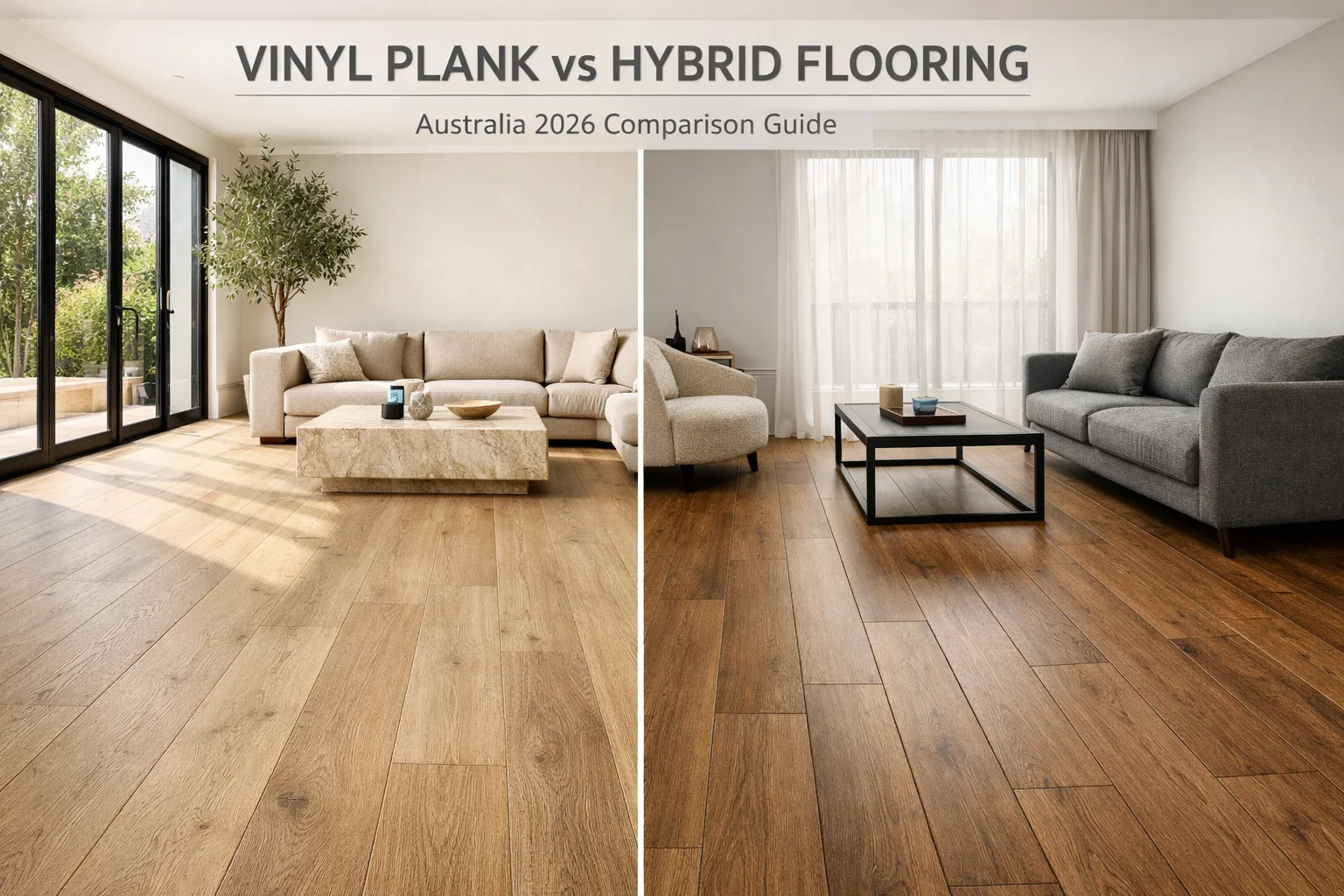
Vinyl Plank vs Hybrid Flooring Australia 2026 – Complete Waterproof Comparison Guide
Choosing between Vinyl Plank vs Hybrid Flooring is one of the most important flooring decisions for Australian homeowners in 2026. Both options are marketed as waterproof, durable and suitable for modern open-plan homes. However, although they look similar, their internal construction, waterproof performance and structural stability differ significantly.
Across Australia, demand for waterproof flooring continues to rise. Slab-on-ground construction, apartment living, underfloor heating and coastal humidity all require moisture-resistant surfaces. Consequently, many homeowners compare Luxury Vinyl Plank vs Hybrid Flooring to determine which option offers better long-term performance.
Hybrid flooring has gained popularity because of its rigid SPC core and enhanced dimensional stability. Meanwhile, modern LVP products in 2026 feature improved wear layers, UV coatings and locking systems. Therefore, understanding both structural design and waterproof capability is essential before making a final investment decision.

What Is Luxury Vinyl Plank (LVP)?
Luxury Vinyl Plank (LVP) is a resilient flooring product designed to replicate natural timber while offering water resistance and durability. It provides a softer underfoot feel while maintaining a fully waterproof surface layer.
LVP Construction Layers
- UV protective coating
- Wear layer (0.3mm–0.7mm common in Australia)
- Decorative timber print film
- Flexible PVC core
- Backing layer (sometimes acoustic attached)
Core Type
LVP uses a flexible PVC core. As a result, it feels softer underfoot but can respond more noticeably to temperature changes compared to rigid-core products.
Is Luxury Vinyl Plank Waterproof?
Yes. High-quality vinyl plank flooring is 100% waterproof at surface level. The PVC core does not absorb water, and the wear layer prevents moisture penetration from spills. Therefore, LVP is suitable for kitchens, laundries and even bathrooms when correctly installed.
However, glue-down vinyl relies heavily on proper subfloor preparation. If excess moisture rises from a concrete slab without an appropriate moisture barrier, adhesive performance may be affected. Consequently, professional installation remains critical.
Typical Thickness (2026 Australia)
- 2.0–2.5mm (Glue-down)
- 4.5–5.5mm (Click system)
- Wear layer: 0.3–0.7mm
Installation Methods
- Glue-down: Direct bonded to subfloor for stability
- Click-lock: Floating installation with expansion gaps
Explore available ranges here:
Vinyl Flooring Collection – A1 Flooring Vic
What Is Hybrid Flooring?
Hybrid flooring combines vinyl surface technology with a rigid composite core. It was specifically developed to improve waterproof stability and structural performance in climates like Australia.
SPC Core Structure
- UV protective coating
- 0.5–0.7mm wear layer
- Decorative timber layer
- Rigid SPC (Stone Plastic Composite) core
- Attached acoustic underlay
Is Hybrid Flooring Waterproof?
Yes. Hybrid flooring is also fully waterproof. The SPC core contains limestone and PVC, which prevents swelling or water absorption. As a result, hybrid flooring performs exceptionally well in high-moisture environments.
Because of its rigid core, hybrid flooring tolerates minor slab moisture variations and temperature fluctuations more effectively than flexible vinyl plank. Therefore, it is often considered the safer long-term choice for Australian slab-on-ground homes.
Thickness & Stability
- 5.5mm–8mm total thickness
- Rigid core prevents denting
- Enhanced dimensional stability under heat exposure
View current options:
Hybrid Flooring Range – A1 Flooring Vic
Hybrid vs Vinyl Construction Breakdown
| Feature | Luxury Vinyl Plank | Hybrid Flooring |
|---|---|---|
| Core Type | Flexible PVC | Rigid SPC core |
| Surface Waterproof | Yes | Yes |
| Core Waterproof | Yes | Yes |
| Thickness | 2–5.5mm | 5.5–8mm |
| Dimensional Stability | Moderate | High |
| Slab Moisture Tolerance | Moderate | Higher |
Performance & Waterproof Flooring Comparison – Vinyl Plank vs Hybrid Flooring
Waterproof Performance
Both products qualify as waterproof flooring options. However, hybrid flooring provides stronger structural stability in wet environments due to its rigid SPC core. Vinyl plank remains waterproof, but installation quality and moisture management are more critical.
Scratch Resistance
Scratch resistance depends primarily on wear layer thickness. Premium 0.5mm+ wear layers in both products perform well under daily residential traffic.
Dent Resistance
Hybrid flooring performs better because its rigid core distributes weight more evenly under heavy furniture.
Heat Resistance (Australian Sun Exposure)
Australian UV exposure can cause expansion in flexible flooring. Hybrid flooring generally handles direct sunlight better due to superior dimensional stability.
Comfort Underfoot
Vinyl plank feels softer and slightly warmer. Conversely, hybrid feels firmer but structurally more stable.

⭐ Star Rating Comparison (2026)
| Category | Vinyl Plank | Hybrid Flooring |
|---|---|---|
| Waterproofing | ★★★★ | ★★★★★ |
| Durability | ★★★★ | ★★★★★ |
| Stability | ★★★ | ★★★★★ |
| Comfort | ★★★★★ | ★★★★ |
| Value for Money | ★★★★ | ★★★★ |
| Overall Performance | ★★★★ | ★★★★★ |
Estimated 2026 Pricing – Australia
Supply Cost per m² (AUD)
| Product | Budget | Mid | Premium |
|---|---|---|---|
| Vinyl Plank | $28–$40 | $40–$55 | $55–$70 |
| Hybrid Flooring | $35–$50 | $50–$65 | $65–$85 |
Installation Cost per m²
| Product | Installation |
|---|---|
| Glue-down Vinyl | $25–$40 |
| Click LVP | $30–$45 |
| Hybrid Flooring | $30–$45 |
Conclusion – Vinyl Plank vs Hybrid Flooring
When comparing Vinyl Plank vs Hybrid Flooring in Australia 2026, both options qualify as waterproof flooring solutions. However, hybrid flooring delivers superior structural stability, dent resistance and heat performance under Australian conditions. Meanwhile, luxury vinyl plank remains a strong, cost-effective choice with softer underfoot comfort.
At A1 Flooring Vic, we assess your slab condition, moisture levels, sun exposure and lifestyle requirements before recommending the most suitable waterproof flooring solution. For regulatory guidance regarding flooring in wet areas, refer to the Australian Building Codes Board (ABCB).
Frequently Asked Questions
Is hybrid better than vinyl plank?
Hybrid flooring is generally more stable and dent-resistant due to its rigid SPC core, although both products are fully waterproof.
Which is more waterproof?
Both vinyl plank and hybrid flooring are waterproof. However, hybrid offers greater structural stability in wet environments.
Is vinyl plank good for bathrooms?
Yes. Vinyl plank is waterproof and suitable for bathrooms when professionally installed with correct sealing and expansion allowances.