


Blog
Acoustic Underlay Requirements in Victoria – Complete NCC & Strata Compliance Guide

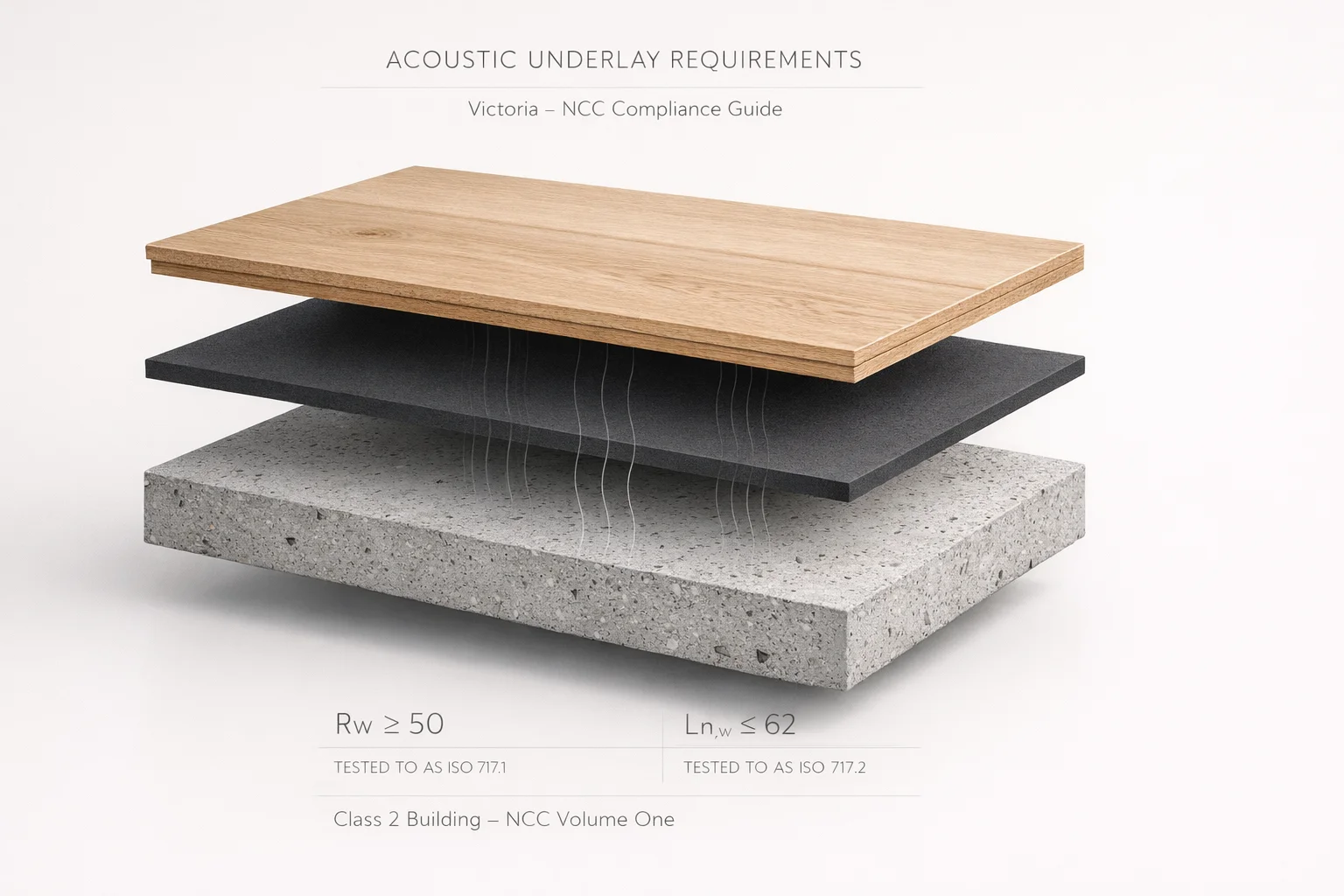
Acoustic Underlay Requirements in Victoria 2026
Apartment living across Melbourne and greater Victoria continues to grow rapidly. As density increases, so do disputes relating to noise transmission between dwellings. Impact noise from hard flooring remains one of the most common strata complaints in high-rise buildings.
Understanding Acoustic Underlay Requirements in Victoria is therefore essential for apartment owners, renovators and investors in 2026. Compliance with the National Construction Code (NCC) and Owners Corporation rules is mandatory in Class 2 buildings. This regulatory guide explains the compliance framework specific to Victoria.
Why Acoustic Compliance Matters in Victoria
Melbourne’s high-rise developments typically use reinforced concrete slabs. While structurally sound, these slabs do not eliminate impact vibration. When carpet is replaced with hybrid or engineered timber flooring, impact sound insulation performance can significantly decline unless a compliant acoustic system is installed.
Owners Corporation Enforcement
Under Victorian legislation, Owners Corporations can enforce building rules and require documented acoustic compliance. Non-compliant flooring may result in breach notices, rectification orders, or legal proceedings through VCAT.
Airborne vs Impact Sound
- Airborne sound – speech, television, music
- Impact sound – footsteps, dropped objects, chair movement
Most apartment acoustic flooring requirements in Victoria relate to impact sound insulation.
NCC Acoustic Underlay Requirements in Victoria
The National Construction Code (NCC) Volume One governs Class 2 buildings across Australia, including Victoria. It establishes minimum airborne and impact sound performance criteria between sole-occupancy units.
Although the NCC applies nationally, enforcement expectations in Victoria are particularly strict in strata environments. Many apartment buildings impose performance standards exceeding NCC minimum requirements.
Table 1 – NCC Acoustic Compliance Requirements (Victoria – Class 2 Buildings)
| Sound Type | NCC Performance Requirement | Minimum Standard (Reference Values) | Applies To | Compliance Risk Level |
|---|---|---|---|---|
| Impact Sound | Limit impact sound transmission between units | Ln,w ≤ 62 (laboratory) | New Build / Renovation | High in retrofits |
| Airborne Sound | Limit airborne sound transmission | Rw + Ctr ≥ 50 | New Build / Major Renovation | Moderate |
| Strata Enhanced | Often exceeds NCC minimum | Commonly Ln,w ≤ 55 | Flooring Replacement | Very High if undocumented |
In practice, most Melbourne apartment renovations require documented evidence that the completed floor system meets the building’s specified Ln,w target.
How Acoustic Underlay Works in Victoria Apartment Systems
Acoustic underlay functions as a resilient decoupling layer between flooring and structural slab. It reduces vibration transmission and improves impact sound insulation Victoria compliance.
Decoupling Principle
Impact vibration transfers mechanically through rigid contact. Underlay interrupts this path by absorbing and dissipating energy.
Density and Compression Resistance
Higher density materials typically provide more consistent long-term acoustic performance. However, thickness alone does not guarantee compliance. Compression resistance and recovery behaviour are equally critical.
Compliance depends on the entire floor system — slab, underlay, flooring material and perimeter treatment.
Types of Acoustic Underlay Used in Victoria
Selection must align with strata flooring acoustic rules Victoria and documented laboratory testing.
Recycled Rubber Underlay
High density, excellent vibration damping and strong long-term stability. Frequently specified for high-rise Melbourne buildings.
High-Density Foam
Moderate performance suitable for compliant hybrid installations when certified.
Cork Underlay
Natural material offering moderate acoustic reduction. Performance varies by density and installation quality.
IXPE Underlay
Integrated in some hybrid systems. Performance varies significantly between manufacturers.
Table 2 – Acoustic Underlay Performance Comparison (Victoria 2026)
| Underlay Type | Density Range | Impact Sound Reduction Potential | Compression Resistance | Long-Term Stability | Suitable Flooring Types | Compliance Reliability |
|---|---|---|---|---|---|---|
| Recycled Rubber | High (700–1000 kg/m³) | High | Excellent | Excellent | Engineered / Hybrid | High |
| High-Density Foam | Medium | Moderate–High | Moderate | Good | Hybrid | Medium |
| Cork | Medium | Moderate | Moderate | Variable | Engineered Timber | Medium |
| IXPE | Low–Medium | Variable | Moderate | Variable | Hybrid (attached) | Low–Medium |
Strata Approval and Documentation in Victoria
Before installing hard flooring, most Owners Corporations require:
- Laboratory acoustic test report
- Manufacturer compliance certificate
- Installation method declaration
- Confirmation of Ln,w performance
Floating versus glue-down systems may alter compliance outcomes. Therefore, documentation must match the proposed installation method.
Installation Factors That Affect Compliance
- Perimeter isolation gaps
- Control of flanking transmission
- Proper slab preparation
- Moisture management
- Use of acoustic sealants where required
Even certified products can fail if installation compromises system integrity.
Common Compliance Mistakes in Victoria
- Using standard foam instead of certified acoustic underlay
- Failing to obtain strata approval
- DIY installation in high-rise apartments
- Ignoring flanking transmission paths
- Assuming waterproof equals acoustic compliant
Professional Guidance on Acoustic Underlay Requirements in Victoria
For Melbourne apartment owners, early compliance consultation is essential. High-density rubber systems are commonly recommended where strict Ln,w targets apply. In sensitive buildings, independent acoustic testing may also be advisable.
For official NCC provisions, refer to the Australian Building Codes Board website: Australian Building Codes Board (ABCB).
If you require professional advice on Acoustic Underlay Requirements in Victoria, strata documentation, or compliant flooring systems, contact the specialists at A1 Flooring Vic:
Contact A1 Flooring Vic – Acoustic Compliance Consultation Engaging compliant suppliers before installation significantly reduces regulatory risk and prevents costly rectification in Victorian apartment buildings.
Frequently Asked Questions
What are the acoustic underlay requirements in Victoria?
Acoustic underlay must enable the completed floor system to meet NCC performance standards, typically Ln,w ≤ 62. Many strata buildings require improved performance.
Does NCC require acoustic underlay for apartments?
The NCC requires acoustic performance, not a specific product. In practice, compliant underlay is necessary when installing hard flooring.
What is the minimum impact sound rating in Victoria?
Laboratory Ln,w ≤ 62 for Class 2 buildings, although stricter strata targets are common.
Do I need strata approval to change flooring?
Yes. Most Victorian apartment buildings require written approval and compliance documentation.
Is rubber underlay better for compliance?
High-density rubber generally provides stronger impact damping and long-term reliability.
What is Ln,w?
Ln,w is a weighted normalised impact sound pressure level measured in decibels. Lower values indicate better insulation.
Does hybrid flooring require acoustic underlay?
In most Melbourne apartments, certified acoustic underlay is required unless the product has integrated, tested compliance.
What happens if flooring is not compliant?
Non-compliance may result in breach notices, mandatory removal and legal proceedings.