


Blog
Engineered Timber vs Solid Timber Flooring Australia 2026

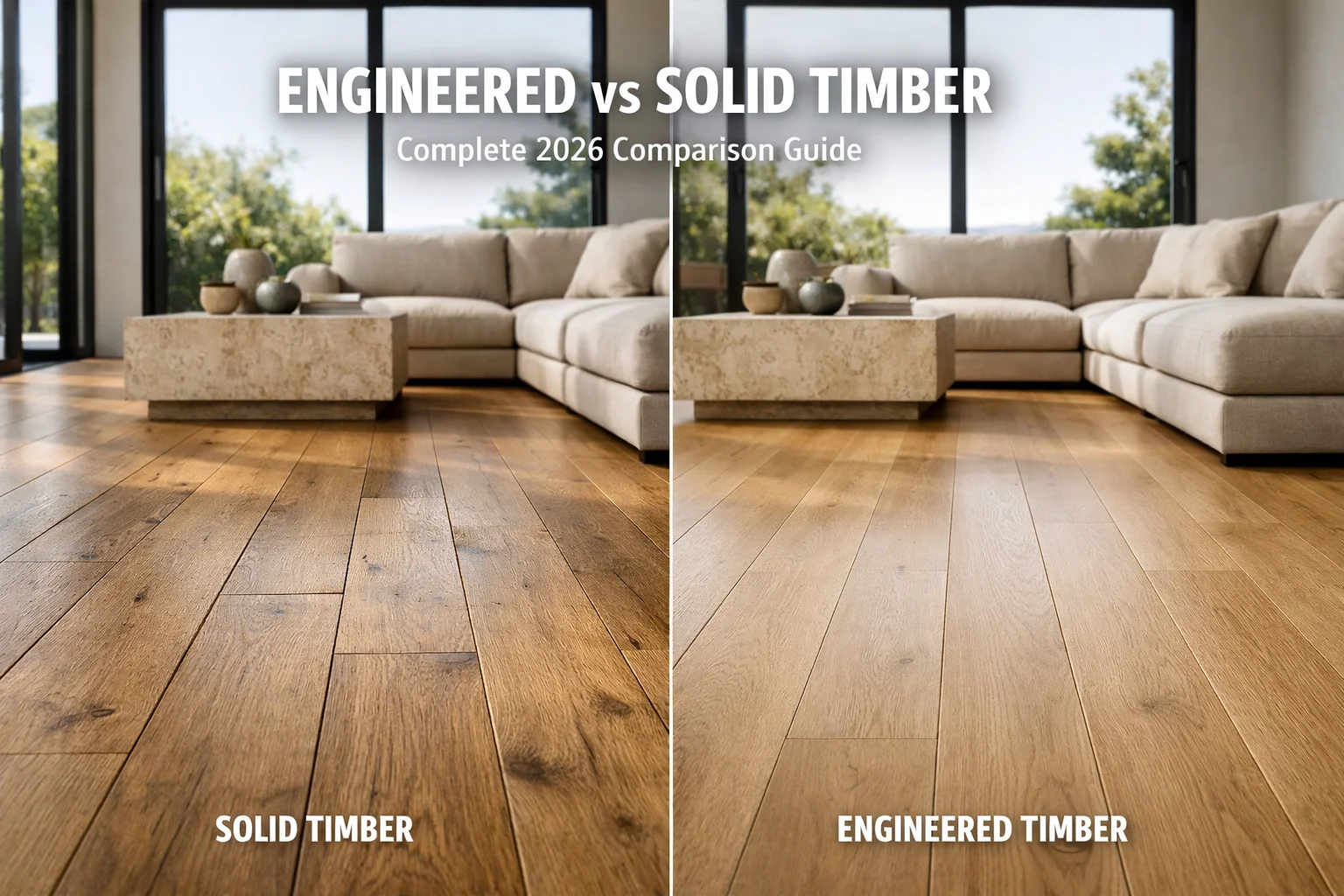
Engineered Timber vs Solid Timber Flooring Australia 2026 – Complete Structural, Cost & Performance Comparison
When comparing Engineered Timber vs Solid Timber Flooring Australia 2026, homeowners must look beyond surface appearance. In modern Australian construction, flooring decisions are heavily influenced by slab-on-ground building methods, moisture control standards, seasonal humidity movement, and long-term lifecycle value.
While both options offer genuine hardwood aesthetics, their internal structure, installation methodology, and environmental performance differ significantly. Therefore, selecting the right product requires a technical understanding of stability, cost implications, and structural compatibility.
This comprehensive Australian 2026 guide provides an analytical comparison covering construction differences, installation cost, lifecycle modelling, subfloor suitability, climate performance, resale value, and hidden risk factors.
Understanding Solid Timber Flooring in Australia
Solid timber flooring is manufactured from a single, continuous piece of hardwood. Popular Australian species include Blackbutt, Spotted Gum, Tasmanian Oak, and Jarrah. Boards are typically milled to 19–22mm thickness and feature tongue-and-groove edges for structural joining.
Core Structural Characteristics
- 100% natural hardwood construction
- Full-depth sanding capability (4–6 refinishes)
- High expansion and contraction response
- Requires moisture-controlled acclimatisation
- Lifespan often exceeding 50 years
Because solid timber consists of one continuous hardwood layer, it reacts directly to humidity changes. As a result, expansion in summer and shrinkage in winter are common in Australian climates, particularly in Melbourne where seasonal variation is pronounced.
Although this natural movement does not indicate failure, it does require careful subfloor preparation and moisture management.
Understanding Engineered Timber Flooring in Australia
Engineered timber flooring is constructed using a layered design. A real hardwood wear layer is bonded to a cross-laminated plywood or hardwood core. This cross-grain structure significantly reduces movement.
Layered Construction Breakdown
- Top layer: Genuine hardwood veneer (2–6mm)
- Core: Multi-layer cross-ply hardwood or plywood
- Base layer: Stabilising backing
Because the internal layers run in opposing directions, engineered timber achieves dimensional stability. Consequently, it performs exceptionally well over concrete slabs and underfloor heating systems — both common in Australian 2026 construction.
Engineered Timber vs Solid Timber Flooring Australia 2026 – Structural Comparison
| Technical Factor | Solid Timber | Engineered Timber |
|---|---|---|
| Core Construction | Single hardwood board | Cross-layered plywood core |
| Dimensional Stability | High movement risk | Low to moderate movement |
| Concrete Slab Suitability | Limited without battens | Excellent compatibility |
| Underfloor Heating | Not recommended | Suitable |
| Refinishing Cycles | 4–6 times | 1–3 times |
| Installation Speed | Slower | Faster |
Given that the majority of new Australian homes are built on slab-on-ground foundations, engineered timber has become the structurally safer option for many projects.

Cost Comparison – Australia 2026 Pricing
| Cost Component | Solid Timber (per m²) | Engineered Timber (per m²) |
|---|---|---|
| Material Supply | $90 – $160 | $70 – $140 |
| Installation Labour | $50 – $80 | $35 – $65 |
| Sanding & Finishing | $40 – $60 | Pre-finished (included) |
| Subfloor Preparation | $10 – $25 | $10 – $25 |
| Total Installed Cost | $190 – $325 | $115 – $230 |
Although solid timber offers long-term refinishing benefits, its higher installation cost and longer site time increase upfront investment. In contrast, engineered timber reduces labour intensity and shortens project duration.
15-Year Lifecycle Cost Projection (100m² Example)
| Cost Category | Solid Timber | Engineered Timber |
|---|---|---|
| Initial Installation | $22,000 | $16,000 |
| Maintenance & Refinishing | $4,000 | $2,500 |
| Repair Risk Allowance | Moderate | Low |
| Total 15-Year Cost | ~$26,000 | ~$18,500 |
Because most homeowners renovate within 15–20 years, engineered timber often delivers better medium-term cost efficiency.
Climate & Moisture Performance in Australia
Australian flooring must tolerate three key environmental conditions:
- Coastal humidity exposure
- Melbourne seasonal fluctuation
- Western Australia dry heat cycles
Solid timber expands during humid periods and contracts in dry seasons. Therefore, visible gapping may occur. Engineered timber, however, maintains greater structural balance under similar conditions.
Hidden Cost Risk Analysis
| Risk Factor | Solid Timber | Engineered Timber |
|---|---|---|
| Moisture Barrier Failure | High impact | Moderate |
| Expansion Gaps | Common | Minimal |
| Installation Delays | More frequent | Less frequent |
| Dust & Disruption | High (onsite sanding) | Low |
Resale & Investment Considerations
From a property value perspective, both flooring types are considered premium natural products. However, buyer perception increasingly values stability and condition over theoretical longevity.
- Owner Occupier (30+ years): Solid timber may justify higher durability.
- Modern Renovation (10–20 years): Engineered timber offers practical value.
- Rental Investment: Engineered timber reduces maintenance claims.
- Apartments: Engineered timber aligns better with slab construction.
Final Verdict – Engineered Timber vs Solid Timber Flooring Australia 2026
When assessing Engineered Timber vs Solid Timber Flooring Australia 2026, the decision must be based on structural context rather than tradition. Solid timber delivers unmatched sanding longevity and heritage appeal. However, engineered timber provides superior stability, lower installation cost, and stronger compatibility with modern slab construction.
For technical guidance and product compliance standards, you can review industry resources from the Forest & Wood Products Australia (FWPA).
If you are exploring premium engineered timber options, browse our current collection here:
Engineered Timber Flooring Range
For tailored advice, moisture testing, or installation consultation, contact our flooring specialists directly:
Contact A1 Flooring VIC
Frequently Asked Questions
Is engineered timber real wood?
Yes. The top layer consists of genuine hardwood, while the core is constructed from cross-layered plywood for stability.
Which performs better in Melbourne climate?
Engineered timber performs better due to reduced seasonal expansion and contraction.
Can engineered timber be sanded?
Yes, depending on wear layer thickness. Most allow 1–3 refinishing cycles.
Does solid timber increase property value more?
In heritage homes, possibly. However, in most modern Australian homes, resale differences are minimal.
Which option is better over concrete slabs?
Engineered timber is structurally more compatible with slab-on-ground construction.